

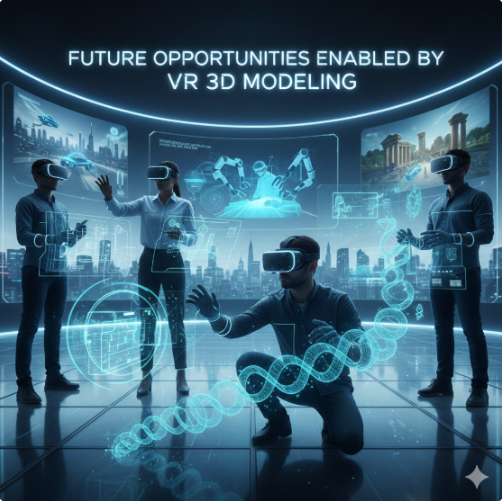
Imagine limitless design – where the ideas are not limited anymore to screens, drawings, or dead models. Rather, you enter into your idea, remodel it with a movement, and lead other people to experience it with you in real-time. This is not science fiction. The future is the one created by VR 3D modeling.
The opportunities that are being unlocked by virtual reality are much more than faster design as virtual reality matures. It is redefining creativity and teamwork, and even the relationship between man and the digital spaces.
A New Era of Experiential Design
The greatest prospect that VR 3D modeling has generated is in the field of experiential design. Instead of creating user-centered designs, creators can create user-friendly designs.
Before any building is constructed, clients, end users, and stakeholders can visit spaces, touch products, and express themselves emotionally. This first-hand engagement gives way to designs that are more natural, humanistic, and needs-oriented. Future-oriented 3D modelling applications are already making VR a co-creating platform, and not a visualization tool.
Democratizing Creativity and Design Access
Conventionally, 3D design only used to take years of technical training. VR is changing that dynamic.
VR 3D modeling makes the barrier to entry lower with gestured interfaces that are intuitive to use. The process of creating objects can be easier and more natural as designers can sculpt, move, and modify objects. The non-designers, including the clients, educators, and entrepreneurs, will play a very active role in creating digital models in the future.
This democratization creates new markets of 3D modeling services, as they have more functions of technical implementation rather than creative facilitation.
Smarter Design Through AI and VR Integration
The combination of VR and AI can be seen as one of the most thrilling opportunities of the future. With the increasing interventions of AI into VR spaces, the process of design will be smarter and more responsive.
Within VR 3D modeling, AI could:
- Recommend real-time design optimization.
- Auto-generates variations by constraint.
- Foresee usability or location problems.
- Help in repetitive modelling.
Such collaboration between AI and VR will enable the designers to concentrate on creativity instead of technical intricacy.
Global Collaboration Without Physical Limits
The issue of geography will be of less concern than ever. The VR 3D modeling allows common virtual workspaces where workers on various continents can work together as though they are in the same room.
Without travelling, design studios, manufacturers, and creative teams can host real-time design reviews, workshops, and design sessions. This change opens opportunities for 3D modeling services to work worldwide, use the talent pool, and provide international customers more easily.
Transforming Education and Skill Development
Learning in the future will be an immersive experience. The modeling environments provided by VRs provide practical training without the need for physical danger or material expenditure.
To study design, engineering, and spatial thinking, students will learn through doing rather than watching. The professional 3D modeling services will be in demand for content, environments, and platforms as VR 3D modeling becomes a normal educational tool.
It opens up opportunities in the long-term in training, certification, and ecosystems of digital education.
New Frontiers in Prototyping and Innovation
Prototyping will be transformed more towards a complete virtual one. VR enables experiments to be quickly done without consuming materials.
In the future, designers can create a prototype of a whole system – a product, a building, or a factory, put it through VR and test it under simulated conditions, perfect it, and then start producing it in real life. The 3D innovation of VR makes it faster, cleaner, and more sustainable.
Expanding Role in Storytelling and Brand Experiences
Immersive storytelling is going to become the primary method used by brands to engage the audience. VR makes it possible to have stories that the audience does not merely view, but they experience.
Through VR 3D modeling, interactive product launches, virtual showrooms, and experiential marketing campaigns can be developed by the brand. This provides innovative opportunities for the creative 3D modeling services to integrate design, narration, and technology in whole new forms.
Conclusion
The possibilities available with VR 3D modeling in the future are much more than efficiency. They are looking at the future of design that is immersive, collaborative, intelligent, and extremely human.
With the constantly changing nature of technologies, 3D modeling services that are not afraid of VR will not merely adjust to the future, but they will influence the future. Thoughts in the future are not visualised in the distance. They are defined, ventured into, and lived–way before they come to pass.